- Introduction
- Begin With The Child’s Age
- Baby Bag Essentials
- Toddler Bag Essentials
- Preschool Bag Essentials
- Ask What The Nursery Provides
- Use A Nursery Checklist
- Pack A Complete Clothing Change
- Consider Packing Two Changes
- Choose Practical Clothing
- Pack Spare Underwear And Socks
- Use A Wet Bag
- Pack Nappies According To Time
- Include Wipes
- Carry A Changing Mat
- Pack Nappy Cream Carefully
- Prepare For Toilet Training
- Include Hand-Cleaning Supplies
- Pack A Suitable Water Bottle
- Check Nursery Bottle Rules
- Pack Familiar Snacks
- Consider Food Allergies
- Use A Suitable Lunch Container
- Keep Cold Food Cold
- Include Feeding Supplies For Babies
- Pack More Than One Bib
- Include A Comfort Item
- Consider A Duplicate Comfort Item
- Pack Sleep Items Only When Required
- Choose A Simple Activity
- Avoid Valuable Toys
- Pack Sun Protection
- Choose A Practical Sun Hat
- Prepare For Rain
- Prepare For Hot Weather
- Prepare For Cool Indoor Spaces
- Include A Small Towel
- Pack Swim Items Separately
- Carry Emergency Contact Information
- Keep Allergy Information Clear
- Pack Medicines Only According To Policy
- Check Medicine Expiry Dates
- Include Basic Adult-Controlled First-Aid Items
- Label Personal Belongings
- Choose The Right Bag
- Do Not Overload A Child’s Backpack
- Organise The Bag Into Pouches
- Put Frequently Used Items Near The Top
- Keep Food Separate From Changing Supplies
- Create A Nursery Bag Refill Station
- Empty The Bag Every Evening
- Adjust The Bag For Short Outings
- Adjust The Bag For Full-Day Trips
- Adjust The Bag For Car Travel
- Adjust The Bag For Public Transport
- Pack For The Return Journey
- Involve Older Children
- Teach Children What Belongs In The Bag
- Common Packing Mistakes
- A Minimal Nursery Bag Checklist
- A Minimal Toddler Day-Trip Checklist
- A Practical Bag-Checking Routine
- Conclusion
- FAQ
- What Should Be In A Nursery Bag?
- How Many Spare Outfits Should I Pack?
- What Is A Wet Bag Used For?
- Should I Pack Food For Nursery?
- What Should I Pack For A Toddler Day Trip?
- Should Medicine Go Inside A Nursery Bag?
- How Can I Keep The Bag Organised?
- Should Every Item Be Labelled?
- How Often Should I Check The Childcare Bag?
- How Can I Avoid Carrying Too Much?
Introduction
Preparing a bag for nursery or a family outing can seem simple until a child needs a clean shirt, a familiar snack, a nappy, a comfort item, or protection from unexpected rain. A well-packed bag helps parents and caregivers respond to ordinary situations without carrying more than they can manage.
The right childcare bag essentials depend on the child’s age, the length of the outing, the weather, food arrangements, toilet needs, and whether the bag is for nursery, an indoor activity, a park, or a full family day trip.
A baby may need nappies, feeding supplies, several clothing changes, and a muslin cloth. A toilet-training toddler may need spare underwear, easy snacks, and a wet bag. An older preschool child may need only one clothing change, a water bottle, sun protection, and a few personal items.
The goal is not to pack everything that could possibly be needed. The goal is to prepare for the situations most likely to happen while keeping the bag organised, safe, and comfortable to carry.
This guide explains practical childcare bag essentials for nursery days and day trips, including clothing, food, drinks, hygiene, comfort, weather protection, medicine information, emergency details, and bag organisation.
👉 “Parents preparing for nursery days and family outings may also explore this practical guide to buying children’s clothes in Thailand for help choosing comfortable everyday outfits.”
Begin With The Child’s Age
Age is one of the most important factors when deciding what to pack.
Babies, toddlers, and preschool children have different needs relating to:
- Feeding
- Nappies
- Toilet training
- Mobility
- Communication
- Clothing changes
- Comfort
- Sleep
- Independence
- Safety
A baby’s bag may contain several feeding and changing items. A preschooler may be able to carry a small backpack containing a water bottle, hat, and light clothing.
Review the bag regularly because children’s needs change quickly.
Baby Bag Essentials
A baby may need:
- Nappies
- Baby wipes
- Changing mat
- Nappy cream
- Disposable bags or wet bags
- Two or more clothing changes
- Bibs
- Muslin cloths
- Feeding supplies
- Water when age-appropriate
- Comfort item
- Sun hat
- Light blanket
- Weather protection
- Emergency information
Pack enough supplies for the planned time plus a small reserve.
Do not overload the bag with full-size products when travel-size containers or nursery-provided supplies are available.
Toddler Bag Essentials
Toddlers often need a mixture of changing, feeding, comfort, and activity supplies.
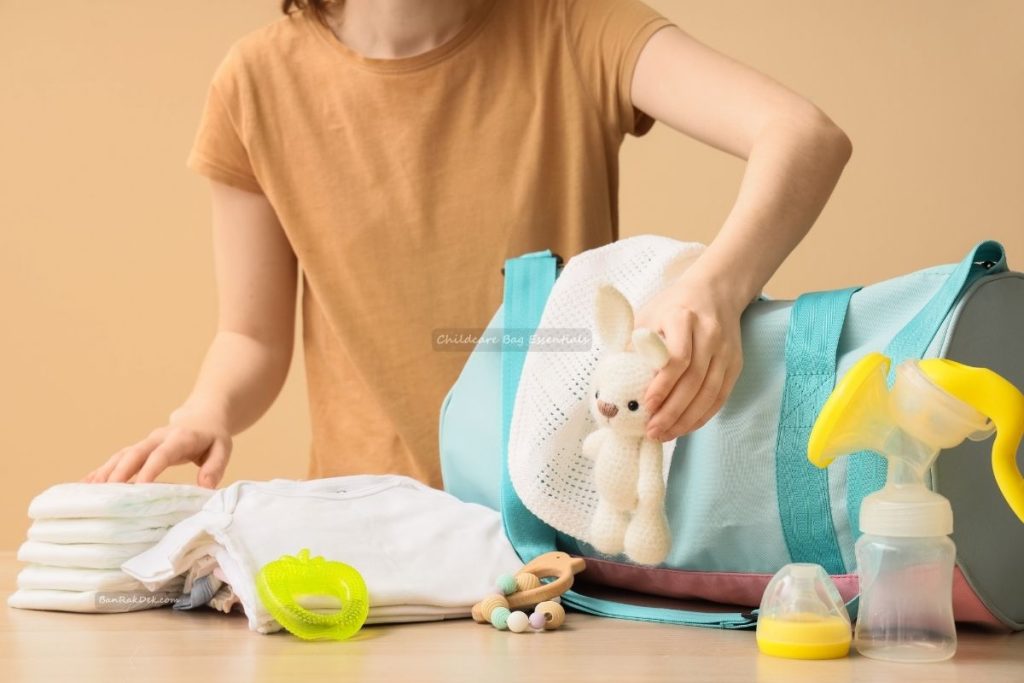
Useful childcare bag essentials for toddlers include:
- Nappies or training pants
- Wipes
- Spare underwear
- Spare shorts or trousers
- Extra shirt
- Socks
- Wet bag
- Water bottle
- Familiar snacks
- Bib
- Sun hat
- Comfort item
- Small activity
- Rain protection
- Emergency contact information
Toddlers may spill drinks, sit on wet surfaces, become dirty during play, or have toilet accidents. One complete clothing change is therefore a practical minimum for many outings.
Preschool Bag Essentials
Preschool children often need fewer changing supplies but still benefit from preparation.
A preschool bag may include:
- One complete clothing change
- Spare underwear
- Water bottle
- Snack or lunch
- Hat
- Light rain jacket
- Tissues
- Wet bag
- Comfort item when needed
- Small activity
- Emergency information
- Any nursery-requested supplies
Older preschool children can help pack and recognise their belongings.
This encourages responsibility while allowing an adult to complete the final check.
Ask What The Nursery Provides
Nurseries differ in what they supply.
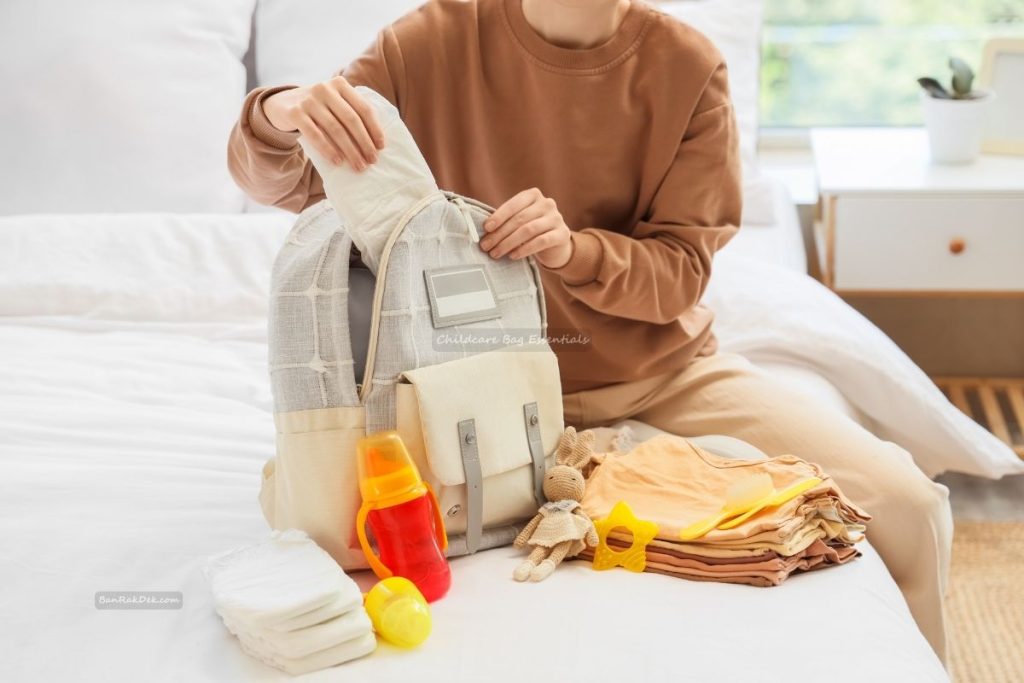
Some may provide:
- Nappies
- Wipes
- Meals
- Snacks
- Drinking water
- Bedding
- Sunscreen
- Art supplies
- Outdoor clothing
- Cups and cutlery
Others may expect families to provide most personal items.
Before preparing childcare bag essentials, ask the nursery:
- How many clothing changes are needed?
- Are nappies and wipes supplied?
- Is food provided?
- Are personal water bottles required?
- Does bedding need to be brought?
- Are comfort items allowed?
- Can medicine be stored?
- How should food be labelled?
- Are nut products prohibited?
- Which items should remain at the nursery?
This prevents unnecessary packing and reduces the risk of forgetting required items.
Use A Nursery Checklist
A simple nursery checklist can include:
Clothing: Complete spare outfit, underwear, socks, and weather items
Changing: Nappies, wipes, cream, and wet bag
Food: Labelled lunch, snacks, bottles, or feeding instructions
Comfort: Approved comfort item or sleep item
Health: Medicine forms and allergy information when required
Identification: The child’s name on personal belongings
Communication: Notes or information requested by caregivers
Keep the checklist near the door or saved on the phone.
Pack A Complete Clothing Change
A complete change should normally include:
- Shirt or top
- Shorts, trousers, or skirt
- Underwear
- Socks
For babies, include:
- Bodysuit
- Top and bottom
- Socks
- Additional bib
One extra shirt alone may not be enough if the child spills a drink over the whole outfit or has a toilet accident.
Place the complete outfit together in a labelled bag so a caregiver can find it quickly.
Consider Packing Two Changes
Two clothing changes may be useful when:
- The child is toilet training
- The day includes water play
- The weather is rainy
- The child is prone to spills
- The outing lasts all day
- The child attends nursery for many hours
- Messy art or outdoor play is planned
For a short indoor outing, one change may be enough.
Adjust childcare bag essentials according to the actual activity rather than following the same list every day.
Choose Practical Clothing
Spare clothing should be:
- Comfortable
- Easy to put on
- Suitable for the weather
- Easy to wash
- Simple for caregivers to identify
- Free from difficult fastenings
- Appropriate for active play
Avoid packing a favourite or delicate outfit for messy nursery activities.
For children learning to use the toilet, choose clothing that can be removed quickly.
Pack Spare Underwear And Socks
Underwear and socks are small but easy to forget.
They may be needed after:
- Toilet accidents
- Water play
- Rain
- Muddy outdoor activities
- Food spills
- Excessive sweating
Pack them in the same pouch as the spare outfit.
Replace used items immediately after the bag returns home.
Use A Wet Bag
A reusable waterproof or water-resistant wet bag is one of the most useful childcare bag essentials.
It can hold:
- Wet clothing
- Dirty underwear
- Used bibs
- Damp towels
- Swimwear
- Muddy socks
- Small spills
Choose a bag that closes securely and can be washed.
A separate disposable bag can be kept as an emergency backup, but avoid relying on thin plastic bags around young children.
Pack Nappies According To Time
A practical approach is to estimate how many nappies the child usually uses during the planned time and add a small reserve.
For example, pack enough for:
- Normal changes
- One unexpected extra change
- A delayed return journey
Nurseries may request a full pack or a daily supply.
Check the bag each evening instead of discovering in the morning that only one nappy remains.
Include Wipes
Wipes are useful for:
- Nappy changes
- Sticky hands
- Food spills
- Dirty faces
- Outdoor dirt
- Cleaning a changing surface
A small travel pack may be easier for day trips.
Keep the package sealed so the wipes do not dry out.
Wipes do not replace proper handwashing when soap and water are available.
Carry A Changing Mat
A foldable changing mat creates a cleaner surface for nappy changes.
Choose one that is:
- Easy to wipe
- Lightweight
- Foldable
- Large enough for the child
- Stored separately from food
Clean it after use and allow it to dry.
Even when a changing station is available, a personal mat can create an additional barrier.
Pack Nappy Cream Carefully
Pack only the cream the child normally uses.
Check whether the nursery requires:
- The original container
- The child’s name
- Written permission
- Application instructions
Do not send an unlabelled container.
Place the cream in a sealed pouch to protect clothing and food if the lid opens.
Prepare For Toilet Training
A toilet-training child may need:
- Several pairs of underwear
- Easy-to-remove clothing
- Spare trousers or shorts
- Socks
- Wet bag
- Wipes
- Training pants
- A familiar portable toilet seat when appropriate
- Simple instructions for caregivers
Tell the nursery or accompanying adult about the child’s usual signs and routine.
Do not pack complicated clothing that makes independent toilet use more difficult.
Include Hand-Cleaning Supplies
Useful hygiene supplies may include:
- Tissues
- Wipes
- A small hand towel
- Hand sanitiser for adult-supervised use
Hand sanitiser should remain under adult control and out of reach of young children.
Soap and water are preferable when hands are visibly dirty or after toilet use.
Pack A Suitable Water Bottle
A child’s water bottle should be:
- Leak-resistant
- Easy to open
- Easy to clean
- Clearly labelled
- Appropriate for the child’s age
- Large enough for the activity
- Free from loose parts
Test it before placing it in the bag.
Keep it upright or in an external bottle pocket when possible.
A leaking bottle can damage spare clothing, documents, food, and comfort items.
Check Nursery Bottle Rules
Some nurseries request:
- A particular bottle type
- The child’s full name
- Daily cleaning
- A measured amount
- Separate milk and water bottles
- No glass containers
- No sweet drinks
Follow the nursery’s system so caregivers can manage bottles safely and consistently.
Pack Familiar Snacks
For a day trip, snacks can help during transport, queues, or unexpected delays.
Possible choices include:
- Fruit
- Crackers
- Simple sandwiches
- Cut vegetables appropriate for the child
- Plain cereal
- Yogurt stored at a safe temperature
- Another familiar food
Choose food according to the child’s age and chewing ability.
Avoid packing foods that present a choking risk or conflict with allergy rules.
Consider Food Allergies
Before sending food to nursery, check whether it has a restricted-food policy.
Common concerns may include:
- Peanuts
- Tree nuts
- Milk
- Eggs
- Soy
- Wheat
- Fish
- Shellfish
- Sesame
Do not assume a homemade snack is safe for the whole group.
Clearly label the child’s food and provide accurate allergy information to caregivers.
Use A Suitable Lunch Container
A good lunch container should be:
- Secure
- Easy for the child or caregiver to open
- Easy to clean
- Clearly labelled
- Suitable for the food
- Free from cracks
- Divided when foods need separation
Avoid sending unfamiliar containers that require difficult instructions.
Check whether the nursery provides refrigeration or expects an insulated lunch bag.
Keep Cold Food Cold
Food requiring refrigeration should remain at a safe temperature.
Use:
- An insulated lunch bag
- Suitable ice packs
- Sealed containers
- Short transport times
Ask whether the nursery transfers food to a refrigerator.
Discard food that has been stored unsafely or left in excessive heat for an uncertain period.
Include Feeding Supplies For Babies
Depending on the baby’s routine, the bag may need:
- Milk or formula prepared according to nursery rules
- Labelled bottles
- Bibs
- Burp cloths
- Baby food
- Spoon
- Feeding schedule
- Storage instructions
Formula and expressed milk require careful handling.
Follow the nursery’s written policies rather than creating a separate method that caregivers may not be able to manage.
Pack More Than One Bib
Babies and toddlers may need more than one bib during a long day.
Choose bibs that are:
- Easy to clean
- Clearly labelled
- Comfortable
- Suitable for the child’s age
- Simple for caregivers to fasten
Store used bibs in the wet bag.
Include A Comfort Item
A familiar object may help a child settle during nursery, travel, naps, or unfamiliar activities.
Possible comfort items include:
- Small soft toy
- Blanket
- Comfort cloth
- Familiar book
- Dummy or pacifier
- Family photograph
Check whether the nursery allows comfort items and how they should be labelled.
Avoid sending an irreplaceable item if losing it would cause significant distress.
Consider A Duplicate Comfort Item
When possible, keep a duplicate of a frequently used comfort item.
One can remain at home while the other travels.
This can help if the item is:
- Lost
- Left at nursery
- Being washed
- Damaged
Introduce the duplicate gradually so it feels familiar.
Pack Sleep Items Only When Required
Nurseries may request:
- Small sheet
- Blanket
- Sleep sack
- Pillowcase
- Comfort toy
Follow the nursery’s safe-sleep policy.
Do not add pillows, loose blankets, or other sleep products for a baby unless the nursery specifically approves them within its safety procedures.
Choose A Simple Activity
For travel or waiting time, pack one or two quiet activities.
Possible options include:
- Board book
- Sticker activity appropriate for the child
- Small drawing pad
- Crayons
- Simple puzzle
- Favourite toy
- Reusable activity board
Avoid filling the bag with many small toys.
Small pieces can be lost and may not be suitable around younger children.
Avoid Valuable Toys
Do not pack toys that are:
- Expensive
- Irreplaceable
- Easily broken
- Difficult to clean
- Made of many small pieces
- Likely to cause disputes in a group setting
A simple, familiar item is usually more practical.
Pack Sun Protection
For outdoor activities, childcare bag essentials may include:
- Sun hat
- Suitable sunscreen
- Lightweight long-sleeved clothing
- Sunglasses when appropriate
- Water
- Small shade cover for a stroller
Follow age-appropriate sunscreen guidance and nursery policies.
Some nurseries require written permission before staff can apply sunscreen.
Label the product clearly and keep it in its original packaging.
Choose A Practical Sun Hat
The hat should:
- Fit securely
- Shade the face
- Feel comfortable
- Be easy to wash
- Have the child’s name
- Avoid unsafe cords
Pack a spare for longer trips when the first may become wet or lost.
Prepare For Rain
Weather can change quickly, so include:
- Lightweight rain jacket
- Stroller rain cover
- Small umbrella for adult use
- Spare socks
- Wet bag
- Quick-drying clothing
Avoid placing a loose rain cover over a stroller without adequate ventilation.
Follow the stroller manufacturer’s instructions.
Prepare For Hot Weather
In hot weather, pack:
- Water
- Light clothing
- Sun hat
- Sunscreen
- Cooling cloth when appropriate
- Spare shirt
- Small towel
- Fan designed for safe supervised use
Plan regular shade and air-conditioned breaks.
A packed bag cannot replace a realistic heat plan. Shorten or change the outing when conditions become uncomfortable.
Prepare For Cool Indoor Spaces
Air-conditioned shopping centres, nurseries, cinemas, and transport can feel cool after being outdoors.
A light layer may be useful, such as:
- Thin cardigan
- Lightweight jacket
- Long-sleeved shirt
- Light blanket for an age-appropriate child
Avoid packing a heavy garment that takes up most of the bag unless the destination requires it.
Include A Small Towel
A small towel can be useful for:
- Sweat
- Water play
- Handwashing
- Spills
- Wet seating
- Cleaning before changing clothes
Pack it in a separate pouch so it remains clean.
After use, place it in the wet bag.
Pack Swim Items Separately
For swimming or water play, include:
- Swimwear
- Swim nappy when required
- Towel
- Dry clothing
- Wet bag
- Sun hat
- Sunscreen
- Water shoes where appropriate
Place the water-play items in one pouch.
This makes it easier to find them without emptying the whole bag.
Carry Emergency Contact Information
A nursery or day-trip bag should contain current contact information.
Include:
- Child’s full name
- Parent or guardian names
- Primary phone number
- Secondary phone number
- Important allergies
- Relevant medical information
- Nursery contact when appropriate
Avoid displaying unnecessary personal details on the outside of the bag.
A small card in a secure internal pocket is often enough.
Keep Allergy Information Clear
For a child with allergies, provide information that is:
- Current
- Easy to read
- Specific
- Consistent with medical advice
- Shared directly with responsible adults
Include:
- Allergen
- Typical symptoms
- Emergency instructions
- Prescribed medicine information
- Emergency contacts
Do not rely only on a label attached to the bag. Speak with caregivers directly.
Pack Medicines Only According To Policy
Nurseries usually have strict rules for medicine.
They may require:
- Original packaging
- Prescription label
- Written permission
- Exact dosage instructions
- Expiry-date check
- Direct handover to staff
- Secure storage
Never place medicine loosely in a child’s bag where the child or another child can reach it.
For day trips, an adult should control all medicine.
Check Medicine Expiry Dates
Review prescribed emergency medicine and routine supplies regularly.
Check:
- Expiry date
- Packaging condition
- Child’s current dose
- Storage requirements
- Whether written plans remain current
- Whether the nursery needs a replacement
Set a reminder before the expiry date.
Include Basic Adult-Controlled First-Aid Items
For family day trips, an adult may carry a small first-aid pouch containing:
- Adhesive bandages
- Sterile gauze
- Saline wipes
- Medical tape
- Disposable gloves
- Any prescribed emergency medicine
- Emergency information
Keep all items inaccessible to children.
A first-aid pouch should support minor care, not replace appropriate medical attention.
Label Personal Belongings
Items can easily be mixed up at nursery.
Label:
- Bag
- Water bottle
- Lunch box
- Clothing
- Hat
- Shoes when required
- Comfort item
- Bedding
- Wet bag
Use labels that remain readable after washing.
Avoid adding more personal information than necessary.
Choose The Right Bag
A childcare bag should be:
- Comfortable to carry
- Easy to clean
- Large enough for essential items
- Organised into practical sections
- Securely closable
- Suitable for the child’s age
- Not excessively heavy
- Easy for caregivers to recognise
A backpack often keeps both adult hands free.
A child’s own backpack should be light and appropriately sized.
Do Not Overload A Child’s Backpack
A young child should not carry all family supplies.
A child-sized bag may contain:
- Water bottle
- Hat
- Light jumper
- Small comfort item
- One activity
An adult should carry heavier items, food requiring temperature control, medicine, and emergency supplies.
Organise The Bag Into Pouches
Separate pouches make childcare bag essentials easier to find.
A simple system is:
Changing pouch: Nappies, wipes, cream, and changing mat
Clothing pouch: Complete spare outfit and underwear
Food pouch: Snacks, bib, spoon, and lunch container
Weather pouch: Hat, rain jacket, and sunscreen
Comfort pouch: Small toy, book, or comfort item
Health pouch: Adult-controlled first-aid supplies and documents
Use washable pouches and labels.
Put Frequently Used Items Near The Top
Items that may be needed quickly include:
- Wipes
- Tissues
- Water bottle
- Snack
- Nappy
- Wet bag
- Hat
Do not bury these beneath spare shoes and heavy containers.
Emergency medicine should remain secure but immediately accessible to the responsible adult.
Keep Food Separate From Changing Supplies
Use separate compartments or sealed pouches for:
- Food
- Nappies
- Used clothing
- Cleaning supplies
- Medicine
This reduces contamination and makes the bag easier to manage.
The wet bag should never share an open compartment with food.
Create A Nursery Bag Refill Station
At home, keep frequently used supplies together.
The station might contain:
- Nappies
- Wipes
- Spare labels
- Clean wet bags
- Snacks
- Small tissues
- Sunscreen
- Spare clothing
- Bibs
Refill the bag when returning home rather than waiting until the rushed morning.
Empty The Bag Every Evening
A daily bag check helps prevent:
- Forgotten wet clothing
- Spoiled food
- Leaking bottles
- Missing nursery notes
- Expired snacks
- Dirty bibs
- Empty wipe packets
- Low nappy supplies
Remove used items, clean the bag when needed, and repack the basics.
Adjust The Bag For Short Outings
For a short indoor outing, the bag may need only:
- One clothing change
- Nappies or toilet-training supplies
- Wipes
- Water
- One snack
- Comfort item
- Emergency information
Do not pack for a full day when you will be close to home and shops.
A lighter bag is easier to carry and organise.
Adjust The Bag For Full-Day Trips
A longer outing may require:
- Additional nappies
- Two clothing changes
- More water
- Several snacks
- Lunch
- Sun and rain protection
- Sleep item
- Wet bag
- Activity
- Adult-controlled first aid
- Portable charger for adult communication
- Return-journey supplies
Consider what will still be needed after the main activity, especially when the child is tired.
Adjust The Bag For Car Travel
For car trips, keep some supplies accessible rather than in the boot.
Useful nearby items include:
- Wipes
- Water
- Snack
- Wet bag
- Clothing change
- Comfort item
- Tissues
Never leave children unattended in a parked vehicle.
Keep loose heavy objects secured so they do not become hazards during sudden movement.
Adjust The Bag For Public Transport
For buses and trains, prioritise:
- Lightweight packing
- Secure closures
- Easy-access tickets or travel cards
- Water
- Small snacks
- One compact activity
- Wipes
- Clothing change
- Comfort item
Avoid attaching many loose items to the outside of the bag.
A backpack keeps hands free for holding the child, stroller, or rail.
Pack For The Return Journey
Parents often focus on reaching the destination but forget the trip home.
Keep one small reserve containing:
- Final snack
- Water
- Clean nappy
- Spare underwear
- Clean shirt
- Comfort item
- Adult phone power
Do not use every supply early unless it is genuinely needed.
Involve Older Children
Preschool children can help select:
- Water bottle
- Hat
- One small toy
- Book
- Spare shirt
- Snack from approved choices
An adult should still check the bag.
Involving the child can make them more aware of their belongings and daily routine.
Teach Children What Belongs In The Bag
Older children can learn simple habits:
- Put the bottle back in its pocket
- Place wet clothing in the wet bag
- Tell an adult when supplies are used
- Keep the bag closed
- Do not share food without permission
- Do not touch medicine
- Recognise their name label
These habits support independence gradually.
Common Packing Mistakes
Packing Too Much
A very heavy bag becomes difficult to carry and organise.
Forgetting A Complete Outfit
A spare shirt is not enough after a major spill or toilet accident.
Mixing Clean And Dirty Items
Use a wet bag to separate used clothing.
Packing Unfamiliar Food
A day trip is not always the best time to depend entirely on food the child may refuse.
Ignoring Nursery Policies
Food, medicine, sunscreen, and comfort items may be subject to specific rules.
Forgetting To Label Items
Unlabelled bottles, clothes, and comfort toys are easily mixed up.
Leaving Medicine In The Child’s Reach
All medicine must remain under responsible adult control.
Failing To Refill The Bag
Empty wipes, missing nappies, and yesterday’s wet clothing create avoidable problems.
Avoiding these mistakes makes childcare bag essentials easier to manage.
A Minimal Nursery Bag Checklist
For a child who no longer needs feeding or nappy supplies, a simple nursery bag may contain:
- Complete spare outfit
- Spare underwear and socks
- Water bottle
- Approved snack or lunch
- Hat
- Wet bag
- Comfort item
- Light weather layer
- Nursery-requested documents
This can be adjusted according to the nursery’s own list.
A Minimal Toddler Day-Trip Checklist
A practical toddler day-trip bag may contain:
- Nappies or training pants
- Wipes
- Changing mat
- Complete clothing change
- Spare underwear
- Wet bag
- Water
- Familiar snack
- Sun hat
- Sunscreen
- Rain jacket
- Comfort item
- Emergency information
Add food, sleep, or swim supplies according to the activity.
A Practical Bag-Checking Routine
Before leaving, ask:
Changing: Are there enough nappies, wipes, and spare clothes?
Food: Is food packed safely and suitable for the child?
Water: Is the bottle filled and leak-free?
Weather: Are sun, rain, heat, and cool indoor spaces covered?
Comfort: Is one familiar item included?
Health: Are allergy and medicine arrangements correct?
Identification: Are important belongings labelled?
Return: Are enough supplies reserved for the journey home?
This check takes only a few minutes once the bag has a consistent system.
👉 “Parents preparing a childcare bag may also explore this helpful guide to everyday baby care items for more ideas on choosing practical essentials.”
Conclusion
The most useful childcare bag essentials are the items that match the child’s age, routine, destination, and length of the day.
Babies usually need more changing, feeding, and clothing supplies. Toddlers often require nappies or toilet-training items, simple snacks, a wet bag, and a familiar comfort object. Preschool children may need only one complete clothing change, water, food, weather protection, and nursery-requested items.
Always pack a complete spare outfit rather than only an extra shirt. Include underwear and socks, and consider a second change for toilet training, rain, water play, or a full nursery day.
A reusable wet bag is one of the most practical childcare bag essentials because it keeps damp or dirty clothing separate from food and clean supplies.
Check what the nursery already provides. Its policies may affect nappies, wipes, food, bottles, sunscreen, medicine, bedding, and comfort items.
Pack familiar, age-appropriate food and use containers that are secure, labelled, and easy to manage. Follow allergy restrictions and keep temperature-sensitive food properly chilled.
Weather preparation should include a hat, sunscreen, light rain protection, water, and a comfortable extra layer for cool indoor spaces.
Comfort items can help with settling, naps, waiting, and travel, but avoid sending an irreplaceable favourite when possible.
Medicine should never be placed loosely in a child’s bag. Follow nursery procedures and keep all medicine under responsible adult control during day trips.
Organise childcare bag essentials into separate pouches for changing, clothing, food, weather, comfort, and health supplies. Keep frequently used items near the top and dirty items completely separated.
Empty the bag every evening, remove old food and wet clothing, refill supplies, and check nursery messages. This simple habit makes the next morning easier.
A well-prepared childcare bag does not need to be large or heavy. It should be practical, easy to carry, and organised well enough that the right item can be found when it is needed.
FAQ
What Should Be In A Nursery Bag?
A nursery bag commonly includes a complete clothing change, underwear, socks, nappies or toilet-training supplies, wipes, water, food when required, a wet bag, weather protection, and a labelled comfort item.
How Many Spare Outfits Should I Pack?
One complete spare outfit is a practical minimum. Pack two when the child is toilet training, attending for a full day, or joining water or messy play.
What Is A Wet Bag Used For?
A wet bag keeps dirty or damp clothing, used bibs, swimwear, and wet towels separate from clean items and food.
Should I Pack Food For Nursery?
That depends on the nursery. Ask whether meals and snacks are provided and whether there are food-allergy restrictions.
What Should I Pack For A Toddler Day Trip?
Pack nappies or training supplies, wipes, spare clothes, a wet bag, water, familiar snacks, a hat, sunscreen, rain protection, and a comfort item.
Should Medicine Go Inside A Nursery Bag?
Medicine should be handed directly to authorised staff according to nursery policy. It should not remain where children can access it.
How Can I Keep The Bag Organised?
Use separate labelled pouches for changing supplies, clothing, food, weather items, comfort items, and health information.
Should Every Item Be Labelled?
Label items likely to be separated from the bag, including clothing, bottles, lunch boxes, hats, bedding, and comfort toys.
How Often Should I Check The Childcare Bag?
Check it every evening. Remove food and dirty clothing, replace used supplies, clean containers, and prepare it for the next day.
How Can I Avoid Carrying Too Much?
Pack according to the child’s age, the outing length, available facilities, and the weather. Carry a small reserve rather than several unnecessary duplicates.